Horses
The OutlawsHorses are essential to the movement and material life of the story: they carry fugitives across state lines, bring suspicious stock into a ranch, and make difficult routes through canyons and mountain roads possible. Their roles range from the named buckskin Jim Dandy, who bears Del Delaney away from town, to anonymous working and riding horses whose condition, color, and handling reveal the purposes and hazards surrounding their riders.
Escape and Mobility
After Del takes money from his mother’s savings and a Winchester that had belonged to his father, he saddles Jim Dandy in the barn and leaves town. He rides north as though heading for Wineglass, then turns southwest once he is out of sight and urges the buckskin into a gallop. The horse enables a deliberately misleading departure: the initial direction conceals Del’s actual route, while the speed carries him away from the place where he fears arrest.
Del keeps riding until he crosses from Montana into Wyoming. He hopes a Wyoming sheriff will be less interested in him than a Montana lawman, so he avoids larger towns, especially county seats. The horse’s use here is practical rather than romantic: riding lets a fugitive choose less-traveled routes and keep distance from the authorities. Del sometimes lives on game he kills and otherwise buys supplies at country stores, making the journey a sequence of movement and resupply rather than a single uninterrupted flight. Rain and occasional snow make the late-spring ride cold and uncomfortable, but he accepts that hardship in exchange for freedom and the alternative of avoiding Deer Lodge penitentiary.
Camp, Work, and Suspicion
During the group’s journey with The Kid, horses shape the arrangement of a cautious riverside camp. About three miles along the road, The Kid directs the riders toward the Little Snake River. They pass through cottonwoods to the north bank, dismount, remove their saddles, and stake the horses out. The choice not to build a fire is explained as a way to avoid giving away the camp’s location if Bull Hammer comes looking for them. In this scene, horses are both necessary companions and a logistical concern: once the party stops, they must be unsaddled and secured, while the camp itself must remain difficult to detect.
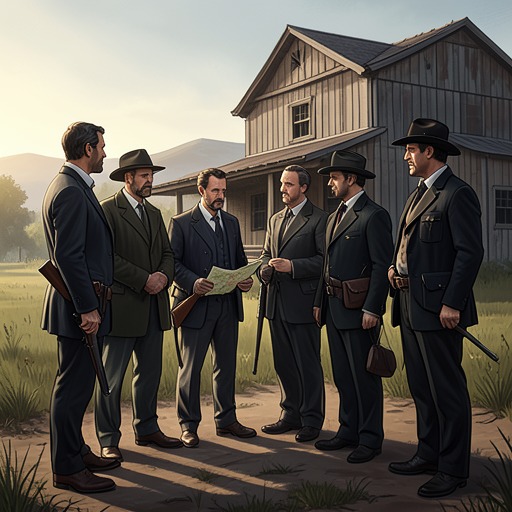
At the J Bar, the horses also become evidence in the narrator’s reading of an unfamiliar crew. Jerry Sewell and four men have driven in a group of horses; all five men wear black and ride black horses. Sewell pays little attention to the ranch hands, while Stub Rawls appears to have unusual latitude over hiring and firing and perhaps ranch business more broadly. Del and his companions initially notice the all-black appearance without knowing what it means. John Smith later suspects Sewell is a horse thief and proposes that the cattle operation serves as a cover; he reasons that the animals could fetch a high price in Colorado, where the law might not be looking for them. Del agrees that Colorado may be their destination. Their explanation for the black clothing is that dark dress would make it harder to see the riders working at night. The account presents this as the men’s suspicion and inference, not as independent confirmation of the horses’ origins.
The arrival of Bull Hammer and his deputy, Rip Hughes, sharpens the tension around the herd. Sewell and his four hardcases are preparing to brand the horses they brought in the previous day when Rawls announces the visitors. Sewell recognizes them, approaches Rawls, and then stops about ten feet away. The waiting riders and the men at the corral remain motionless. Del notices Sewell’s alarm, a reaction that makes the ordinary ranch task of branding newly driven stock feel charged with risk. The horses are not merely background to the confrontation: their presence at the corral puts the suspected operation in the act of processing the animals when authority arrives.
Routes Through the Mountains
Later, horses make possible a long ride from town toward the Diamond M Ranch. Del leaves at sunrise and follows the judge’s directions down a canyon, past the turnoff to Aunt Becky’s place, and south alongside a river. As the canyon opens into a valley, the terrain changes; near noon, he leaves the greener mountain country for desert scrub and rides across an alfalfa field to the ranch buildings. The journey is measured through riding time and changing ground, establishing how much distance separates the people Del is trying to protect from the ranch where he must confront Max Landon.
Landon himself arrives from the river on a large roan, riding with the ease of an experienced horseman. The contrast between Del’s hostile expectations and the man he sees is part of the introduction: Landon initially appears handsome and physically unremarkable, although Del finds his eyes exceptionally cold. The roan supplies the scene’s clearest outward sign of Landon’s riding skill, but the horse does not soften the danger Del associates with him. A capable rider can move confidently through this country and reach the ranch from the river, while the encounter turns on the threat Del perceives in the rider rather than any action by the animal.
The later journey with Kate Muldoon and John Smith depends on finding a usable route toward the mines. The party rides upstream through a narrow canyon, with Del about fifty yards ahead of Kate. He positions himself in front because he expects to draw the first shot if Landon has set an ambush; he hopes the others might then retreat or find shelter, though he doubts that would keep Kate safe. The horses carry the group into a confined landscape where their spacing and direction matter to the plan.
The route is difficult to identify because the old road to the Enterprise Mine has changed after years of disuse and grading. Kate recognizes a rock formation her father called the Old Man and points out where she believes the track lies. Del turns up a steep bank; the ground gives beneath his horse’s hooves, but the animal strains uphill to a gentler slope. After the others catch up, Kate spots wheel ruts in the aspens. They follow them to a clearing and then into a narrow canyon where the ruts are deeper. The horse’s effort makes the terrain concrete: locating the route requires more than choosing a direction, because the party must also get its mounts up unstable ground and through the concealed approach.
Risk in Roily and Narrative Significance
The ride brings the party to the North Star Mine, which appears maintained rather than abandoned: smoke rises from a shack, and a man emerges carrying a rifle ready. Del briefly fears that Landon has placed someone there to watch for them, but the man makes no hostile move as they pass. From the mine, the road toward Roily is clear and seems recently used. The riders descend until they can see the town below, then continue into it. Their horses bring them to the threshold of a new danger, but the town’s unnerving quiet—not any event involving the animals—alerts Del to possible trouble.
At Roily, reaching the livery stable without crossing more of Main Street than necessary is part of managing that risk. Del notices the stable is at the upper end of the block; he and Smith steer close to the eastern boardwalk and turn through the stable archway. Del dismounts and helps Kate down. The stableman comes from the rear and stares at her in disbelief. The horses have delivered the party into town and into shelter, but the stable is also a place where their arrival becomes visible to a local observer.
Across these episodes, horses are instruments of mobility, labor, and exposure. Jim Dandy gives Del a fast, indirect escape; the staked mounts shape the precautions of a hidden camp; the black horses and the attempted branding contribute to suspicions about Sewell’s crew; and the horses carrying Del’s later party must negotiate steep, overgrown routes before the group can reach Roily. Their significance lies in the practical conditions they impose and the possibilities they open: a horse can extend a fugitive’s range, make a perilous approach possible, or bring a rider into view at exactly the wrong place.